How to Ride Buses in Japan: Step-by-Step Guide
Introduction – Why Buses Are Useful for Travelers
Japan is famous for its trains, but buses are often the only way to reach certain temples, mountains, or countryside spots. In cities like Kyoto, buses are essential for sightseeing. However, the bus system in Japan can be confusing for first-time visitors. This step-by-step guide explains how to ride buses in Japan smoothly, even if you don’t speak Japanese.
Step 1: Find the Right Bus Stop
- Look for bus stops marked with a round sign.
- Major tourist areas have bilingual maps showing routes.
- Apps like Google Maps provide real-time bus directions.
Step 2: Boarding the Bus
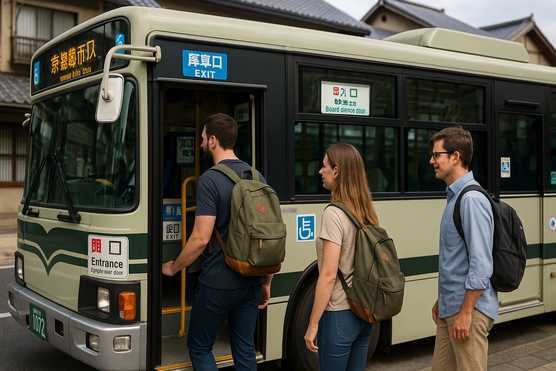
In most cities (Kyoto, Sapporo, Hiroshima), board from the rear door and exit from the front. In Tokyo and some other cities, boarding is often from the front. Always check the local system.
Step 3: Take a Ticket or Tap Your IC Card
Ticket system: Take a small numbered ticket when you board. The number corresponds to your fare zone.
IC card system: Tap your Suica, Pasmo, or ICOCA card at the reader when boarding.
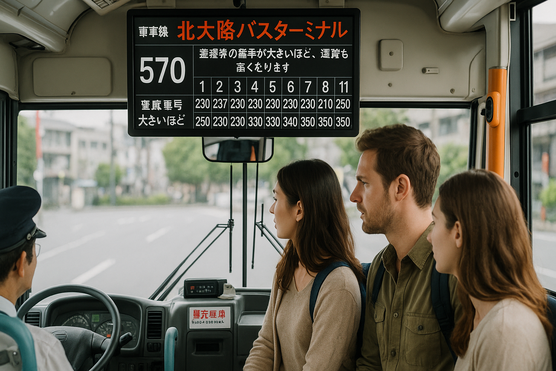
Step 4: Check the Fare Board
Above the driver, you’ll see an electronic board with fare amounts. Match your ticket number with the fare displayed to know how much to pay. If using an IC card, the system calculates automatically.
Step 5: Paying the Fare
Payment is made when you exit (in most cities). Insert coins/bills and your ticket into the fare box. If using IC card, tap again at the exit. Exact change only—use the change machine near the driver.
Step 6: Exiting the Bus
Exit from the front door near the driver. Tap your card or insert your ticket. Say a quick “Arigatou” to the driver—it’s polite and appreciated.

Special Cases: Flat Fare vs. Distance Fare
- Kyoto City Buses: Flat fare system (one price for most trips).
- Regional Buses: Distance-based fare, pay according to zones.
- Airport Buses: Fixed fare, luggage space included.
Etiquette on Japanese Buses
- Keep your voice down, avoid phone calls.
- Priority seating for elderly, disabled, and pregnant passengers.
- Don’t block the aisle with luggage.
- Line up in order when waiting at the stop.
Tips for Tourists
- Always carry some coins for buses that don’t take cards.
- Download Google Maps for bus route navigation.
- If confused, show your destination to the driver—they’ll try to help.
- Avoid peak commuting hours if possible.
How Our Service Helps
Our focus is on restaurant and activity reservations, but understanding how to ride buses ensures you can reach the off-the-beaten-path dining spots we recommend in Kyoto, Nara, and other regions.
Conclusion
Buses in Japan may seem complicated at first, but once you know the system—rear boarding, ticket or IC card, fare on exit—they’re straightforward. With this step-by-step guide, you’ll be ready to explore Japan like a local.
👉 Ready to explore Japan beyond the trains? Let us handle your reservations while you master the bus system.
Related Articles: Smart Tips for Getting Around Japan
- 🗾 Transportation in Japan: The Complete Guide for Tourists
All-in-one overview of trains, buses, taxis, IC cards, and passes. - 🚆 How to Use Tokyo’s Trains: Complete Guide for Tourists (Metro, JR, Suica & Transfers)
Navigate JR and Metro like a local with clear transfer tactics. - 💳 How to Use IC Cards in Japan (Suica, PASMO, ICOCA)
Tap-and-go for trains, buses, vending machines, and shops. - 🚄 How to Take the Shinkansen in Japan: Step-by-Step Guide
Tickets, seat types, boarding flow, and oversized baggage rules. - 🧳 How to Use Coin Lockers in Japan: Step-by-Step Guide for Tourists
Find lockers, pay by cash or IC card, and retrieve easily with QR or PIN code. - 📶 How to Use Free Wi-Fi & SIM/eSIM in Japan
Best options for eSIM, pocket Wi-Fi, and reliable hotspots. - 🚻 How to Use Japanese Public Restrooms (Etiquette & Tips)
Washlet buttons, squat toilets, and accessibility features. - 📞 Emergency Numbers in Japan: Police, Fire & Ambulance
110 / 119 and English-speaking hotlines you should save. - 🧭 What to Do if You Get Lost in Tokyo
Step-by-step actions, helpful phrases, and the right apps. - 🔌 How to Charge Your Phone & Use Power Plugs in Japan
Plug types, voltage, free charging spots, and CHARGE SPOT rental guide. - 🏨 First-Time Travel to Japan: 20 Essential Tips Every Visitor Should Know
Comprehensive travel advice — from trains and cash to culture and safety.