How to Visit a Hospital or Pharmacy in Japan: A Complete Guide for Foreign Travelers

Feeling unwell in a foreign country can be stressful. The good news: Japan’s healthcare system is modern, efficient, and increasingly prepared to help English-speaking travelers. This guide shows you how to find hospitals and clinics, what to expect during a visit, and how to get medicines safely at pharmacies.
1. How Japan’s Healthcare Works
- Hospitals/clinics and pharmacies are separate: you’ll receive a prescription and go to a pharmacy to get medicine.
- Payment: Visitors usually pay first, then claim reimbursement from travel insurance.
- Appointments: Some facilities accept walk-ins, others require advance booking.
2. Finding an English-Speaking Hospital or Clinic
Use these reliable resources to locate suitable facilities in Tokyo, Osaka, Kyoto, Fukuoka, and beyond:
| Service | Description | Link |
|---|---|---|
| JNTO Medical Institution Search | Official multilingual database of clinics and hospitals serving foreigners. | jnto.go.jp |
| Tokyo Himawari (Tokyo Gov.) | Finder for English/multilingual medical institutions in Tokyo. | himawari.metro.tokyo.jp |
| Japan Healthcare Info (JHI) | English navigation & appointment support (paid service). | japanhealthinfo.com |
Your embassy website may also list recommended clinics (e.g., U.S. Embassy Tokyo, UK in Japan).
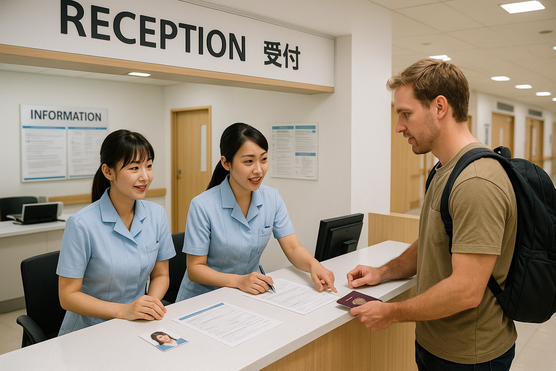
3. What to Expect During a Hospital/Clinic Visit
- Registration: Show passport/insurance, complete a patient form (many are bilingual).
- Consultation: Doctor examines symptoms; tests may be requested if needed.
- Payment: Pay at the cashier; request an itemized receipt for insurance claims.
- Prescription: Take the prescription sheet to a pharmacy (see next section).
Use ER (Emergency) for serious or life-threatening cases only. For common illnesses (fever, cold, stomach pain), visit a general/internal medicine clinic (naika).
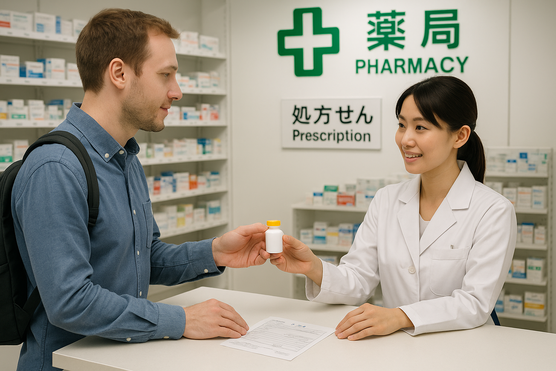
4. Getting Medicine at a Pharmacy (薬局 / Yakkyoku)
Pharmacies are usually separate from hospitals. Look for signs that read くすり / 薬 or a blue/green cross.
| Type | Description |
|---|---|
| 調剤薬局 (Chouzai Yakkyoku) | Prescription-only dispensary. Often located near hospitals/clinics. |
| ドラッグストア (Drugstore) | OTC medicines plus daily goods and cosmetics. |
| 24-hour Pharmacies | Less common; found mainly in large urban areas. |
Bring your prescription sheet (処方せん). Pharmacists explain dosage and timing, and many provide simple English labels or pictograms.
5. Payment, Costs, and Insurance
- Upfront payment: Keep receipts for travel insurance reimbursement.
- Typical costs (approx.): Clinic ¥5,000–10,000 / Hospital with tests ¥10,000–30,000 / Prescriptions ¥2,000–6,000.
- Payment methods: Major hospitals accept cards; small clinics may prefer cash.
If immediate payment is difficult, contact your embassy; some can issue support letters in certain situations.
6. Emergency & After-Hours Care
- Ambulance/Fire: Call 119 (say “Ambulance, please — English OK?”).
- Police: Call 110.
- 24/7 Multilingual Hotline (JNTO): Japan Visitor Hotline — +81-50-3816-2787.
7. Helpful Phrases (Romaji)
- I feel sick. — Kibun ga warui desu.
- I have a fever. — Netsu ga arimasu.
- I have an allergy. — Arerugii ga arimasu.
- My stomach hurts. — Onaka ga itai desu.
- I lost my medicine. — Kusuri o nakushimashita.
8. Summary
Use official finders like JNTO and Tokyo Himawari, bring your passport and insurance details, and remember that pharmacies are separate from hospitals. With a little preparation and the phrases above, getting medical help in Japan is straightforward.
Related Articles: Smart Tips for Getting Around Japan
- 🗾 Transportation in Japan: The Complete Guide for Tourists
All-in-one overview of trains, buses, taxis, IC cards, and passes. - 🚆 How to Use Tokyo’s Trains: Complete Guide for Tourists (Metro, JR, Suica & Transfers)
Navigate JR and Metro like a local with clear transfer tactics. - 💳 How to Use IC Cards in Japan (Suica, PASMO, ICOCA)
Tap-and-go for trains, buses, vending machines, and shops. - 🚄 How to Take the Shinkansen in Japan: Step-by-Step Guide
Tickets, seat types, boarding flow, and oversized baggage rules. - 🧳 How to Use Coin Lockers in Japan: Step-by-Step Guide for Tourists
Find lockers, pay by cash or IC card, and retrieve easily with QR or PIN code. - 📶 How to Use Free Wi-Fi & SIM/eSIM in Japan
Best options for eSIM, pocket Wi-Fi, and reliable hotspots. - 🚻 How to Use Japanese Public Restrooms (Etiquette & Tips)
Washlet buttons, squat toilets, and accessibility features. - 📞 Emergency Numbers in Japan: Police, Fire & Ambulance
110 / 119 and English-speaking hotlines you should save. - 🧭 What to Do if You Get Lost in Tokyo
Step-by-step actions, helpful phrases, and the right apps. - 🔌 How to Charge Your Phone & Use Power Plugs in Japan
Plug types, voltage, free charging spots, and CHARGE SPOT rental guide. - 🏨 First-Time Travel to Japan: 20 Essential Tips Every Visitor Should Know
Comprehensive travel advice — from trains and cash to culture and safety.